Free Confidential IT Recycling for Schools
Schools across the UK regularly replace computers, laptops, servers, tablets, printers and other technology. But getting rid of old equipment is not as simple as putting unwanted devices aside. School IT equipment can contain personal, financial and confidential information that must be handled carefully before the equipment is reused, recycled or disposed of.
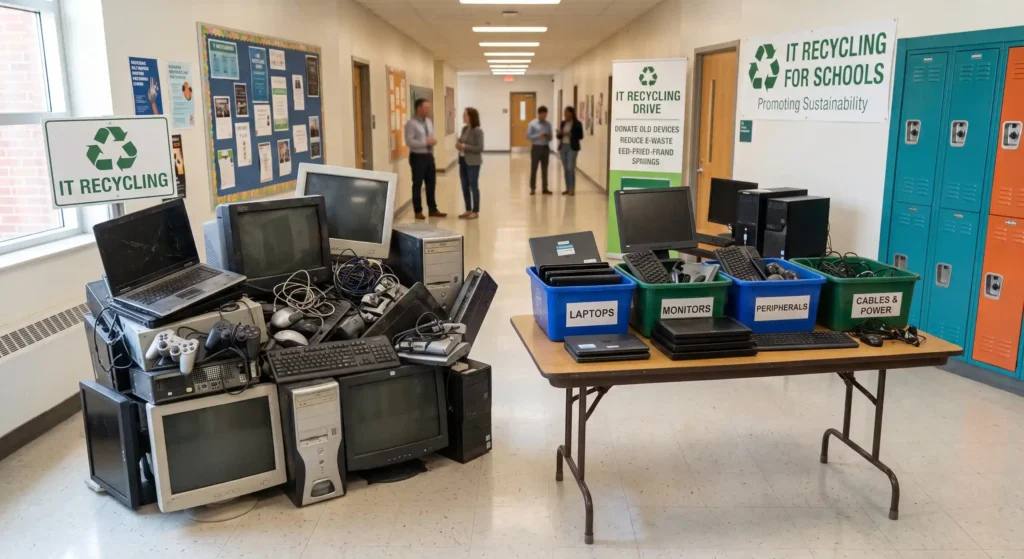
Free confidential IT recycling for schools provides a practical way to manage redundant technology while addressing data security and responsible electronic waste management. Depending on the quantity, type, quality and location of the equipment, free collection may be available through Computer Waste Recycling.
For schools, academy trusts and other education organisations, a proper IT disposal process should cover more than collection. It should consider secure data destruction, asset tracking, documentation, reuse, refurbishment and appropriate WEEE recycling.
This guide explains how school IT recycling UK services work, what equipment can be recycled, why secure data destruction matters and what schools should look for when choosing an IT recycling company.
What Is Free Confidential IT Recycling for Schools?
Free confidential IT recycling for schools combines the collection of redundant technology with secure handling of equipment that may contain sensitive information.
The word confidential is particularly important in education. Computers, laptops and storage devices may contain pupil information, staff records, contact details, financial information, emails and other school data.
The Information Commissioner’s Office has specifically advised schools that when records and equipment containing personal information are disposed of, the information should not be retrievable.
A professional school IT recycling service can therefore provide a controlled route from collection through data destruction and recycling.
Understanding School IT Recycling
School IT recycling involves collecting unwanted or obsolete electrical and electronic equipment and directing it toward appropriate reuse, refurbishment, recovery or recycling routes.
This may include:
- Desktop computers
- Laptops
- Chromebooks
- Servers
- Monitors
- Tablets
- Printers
- Networking equipment
- Routers and switches
- Phones and other IT equipment
Computer Waste Recycling states that it provides secure recycling for a broad range of IT infrastructure, including computers, laptops, servers, networking equipment, mobile devices, routers, printers and monitors.
Why Schools Need Secure IT Disposal
Old equipment should never automatically be treated as ordinary waste.
A computer that no longer works for a school can still contain data on its hard drive or SSD. Simply deleting files, removing shortcuts or performing a basic factory reset may not be sufficient for every situation.
Schools therefore need to consider secure IT disposal for schools as part of their wider information-security process.
The Risks of Improper IT Equipment Disposal
Poor disposal practices can create several problems.
The most obvious is data exposure. If a storage device leaves school control without appropriate data sanitisation, information could potentially be recovered.
There are also environmental considerations. Electrical and electronic equipment should be managed through appropriate waste and recycling channels rather than simply being sent to landfill.
The UK’s WEEE framework is designed to encourage the recovery, reuse and recycling of electrical and electronic equipment and reduce the amount of WEEE going to landfill or incineration.
Why Secure Data Destruction Is Essential for Schools
Secure data destruction should be one of the first considerations when disposing of school IT equipment.
A school may have hundreds of devices distributed between classrooms, offices, libraries, laboratories and storage areas. Each device needs to be considered before it leaves the organisation.
Protecting Sensitive Student Information
School devices can potentially contain information relating to:
- Pupils
- Parents and guardians
- Teachers
- Support staff
- Governors
- Suppliers
- Financial transactions
- Internal communications
This makes data destruction for schools an important part of responsible IT asset disposal.
The ICO’s school data protection guidance highlights secure disposal and says personal information should not be retrievable when records and equipment are disposed of.
GDPR-Compliant IT Recycling Requirements
GDPR and UK data protection requirements do not mean that every old computer must automatically be physically destroyed. The appropriate approach depends on the circumstances, the type of information involved and the organisation’s security requirements.
However, schools should have a clear process for removing or destroying information before equipment is released.
That is why GDPR compliant IT recycling should involve more than simply transporting unwanted devices away.
A responsible provider should be able to explain:
- How equipment is collected.
- How assets are tracked.
- How data-bearing devices are identified.
- Which data destruction method is used.
- What documentation is provided after processing.
Methods of Confidential Data Destruction
Different devices and projects may require different approaches.
Common methods include:
- Secure data wiping
- Data sanitisation
- Physical destruction
- Hard drive shredding
- Destruction of storage media
Computer Waste Recycling describes data destruction methods including software-based wiping, degaussing and physical destruction such as shredding or crushing, depending on the requirements of the project.
For schools, the important point is to select a process that matches the sensitivity of the data and the organisation’s disposal requirements.
What School IT Equipment Can Be Recycled?
A school IT clearance can involve far more than desktop computers.
School Computer Recycling
School computer recycling can cover desktop PCs and all-in-one computers that are no longer required.
Before recycling, each computer should be assessed to determine whether it contains data and whether the hardware has potential for reuse or refurbishment.
Equipment that is suitable for another use may have value beyond its original purpose, while equipment that cannot be reused can enter an appropriate recycling route.
School Laptop Recycling
School laptop recycling is particularly relevant as schools increasingly use portable devices for teaching and administration.
Laptops may contain:
- Internal SSDs
- Hard drives
- User accounts
- Saved documents
- Emails
- Browser information
- School applications
- Locally stored personal information
Computer Waste Recycling specifically lists laptops among the equipment it collects and recycles and states that its process addresses both sensitive SSD data and lithium batteries.
Network and Server Equipment
Schools may also have redundant:
- Servers
- Network switches
- Routers
- Firewalls
- Storage equipment
- Other networking hardware
Servers and network devices can be particularly important during a large IT asset disposal project because they may contain configuration information or storage media.
Other Educational Technology Equipment
A school technology refresh can also generate:
- Tablets
- Interactive displays
- Projectors
- Printers
- Monitors
- Mobile phones
- Cables and accessories
- Other electronic equipment
A complete school electronics recycling service should establish what can be collected before the project begins.
How Free IT Recycling for Schools Works
The exact process varies according to the provider and the equipment involved. A typical project should be organised around security, accountability and responsible recycling.
Booking a Free Collection
The first step is usually to provide details about the equipment.
This can include:
- Equipment type
- Approximate quantity
- Location
- Condition
- Whether devices contain storage media
- Preferred collection date
Computer Waste Recycling states that free collection generally depends on the quantity, quality and type of IT equipment and the collection location.
That means schools should confirm eligibility rather than assuming every collection will automatically be free.
Asset Inventory and Tracking
Asset tracking helps create a clearer record of what has been collected.
For larger school IT asset disposal projects, an inventory can record information such as:
- Device type
- Make and model
- Serial number
- Asset number
- Quantity
- Processing outcome
Computer Waste Recycling describes its process as including an audit and inventory stage where items are checked, counted and recorded.
Secure Data Destruction Process
After collection, data-bearing devices can be processed according to the agreed destruction requirements.
This may involve secure data erasure or physical destruction.
For highly sensitive storage media, hard drive shredding may be appropriate where physical destruction is required.
Recycling, Refurbishment and Reuse
Not every old computer needs to become waste immediately.
Some equipment may have remaining useful life and can potentially be refurbished or recovered for reuse.
Computer Waste Recycling says collected equipment is assessed for reuse, refurbishment, recycling or secure data destruction.
This approach supports sustainable IT recycling by considering recovery and reuse before final material recycling where appropriate.
Receiving Compliance Documentation
Documentation is another important part of professional IT disposal.
Depending on the service and project, schools may need records relating to:
- Collection
- Asset inventories
- Data destruction
- Recycling
- Certificates
- Waste documentation
A documented asset audit trail gives schools a clearer record of what happened to equipment after it left their premises.
Benefits of Free Computer Recycling for Schools
Using a structured free computer recycling for schools service can offer several practical advantages.
Reduce IT Disposal Costs
Schools and academy trusts need to manage budgets carefully.
Where equipment and location meet a provider’s free-collection criteria, schools may be able to arrange collection without paying a standard collection charge.
Computer Waste Recycling currently states that most commercial clients receive a free collection service, subject to eligibility.
Improve Data Security
A controlled disposal process reduces the risk associated with unmanaged equipment leaving the school.
Secure data destruction can help ensure that information stored on redundant devices is not simply passed into an uncontrolled recycling stream.
Support Sustainability Goals
Responsible education sector IT recycling can help schools manage electronic waste more sustainably.
The WEEE framework encourages recovery, reuse and recycling of electrical and electronic equipment.
Schools can therefore consider recycling as part of broader environmental and sustainability policies.
Meet GDPR and WEEE Compliance Requirements
There is no single recycling process that automatically makes every organisation compliant with every requirement.
Instead, schools should use appropriate data protection and waste management processes.
The WEEE regulations provide the UK framework for managing waste electrical and electronic equipment, while schools also need to consider their obligations around personal information.
Free Up Valuable Storage Space
Old IT equipment often ends up stored in cupboards, classrooms, server rooms or maintenance areas.
A planned collection can remove redundant technology and make space available for equipment that is actually being used.
GDPR-Compliant IT Recycling for Schools
GDPR compliant IT recycling should begin with understanding what information is stored on the equipment.
Understanding GDPR Responsibilities
Schools handle significant amounts of personal information. Data protection responsibilities continue to matter when equipment reaches the end of its useful life.
The ICO’s guidance for schools specifically identifies secure disposal as an important consideration.
Data Security During IT Disposal
A secure disposal procedure should consider the entire journey of the device:
School → Collection → Secure handling → Data destruction → Reuse/recycling → Documentation
This is why confidential data destruction for educational institutions should not be treated as an afterthought.
Importance of Certificates of Data Destruction
Where data destruction is performed, schools may need evidence that the agreed process was completed.
Computer Waste Recycling states that its data destruction service provides documentation and certificates and describes full audit trails as part of its commercial data destruction service.
Schools should ask the provider exactly what certificate or documentation will be supplied and what information it contains.
Maintaining an Audit Trail
An audit trail can help answer important questions later:
- What equipment was collected?
- When was it collected?
- Where did it go?
- What happened to the data?
- Was the device reused, refurbished or recycled?
- What documentation was issued?
This is especially useful when schools are managing large equipment refreshes.
WEEE Recycling for Schools Explained
WEEE recycling for schools refers to the responsible management of waste electrical and electronic equipment.
The UK government states that the WEEE regulations are intended to reduce electrical and electronic waste being sent to landfill or incineration while encouraging recovery, reuse and recycling.
What Is WEEE Compliance?
WEEE stands for Waste Electrical and Electronic Equipment.
IT equipment falls within the broader electrical and electronic equipment framework. Government guidance identifies IT and telecommunications equipment as one of the categories covered by the WEEE Regulations.
Why WEEE Regulations Matter for Schools
Old computers should not simply be treated as ordinary rubbish.
Responsible WEEE compliant IT recycling considers how equipment is collected, handled, treated, recovered and recycled.
For a school, choosing a provider that understands environmental compliance can simplify the disposal process.
Environmental Benefits of Responsible IT Recycling
Electronic equipment contains materials that can be recovered and reused.
Proper electronic waste recycling UK services can help keep valuable materials within appropriate recovery streams while reducing unnecessary waste.
Reducing Electronic Waste Across the UK
Whether a school is located in London, Birmingham, Manchester, Leeds, Liverpool, Glasgow, Edinburgh, Bristol or Nottingham, the underlying principles remain similar: secure the data, control the equipment, document the process and send WEEE through appropriate recycling channels.
Choosing the Right School IT Recycling Company
Choosing an IT recycling company should not be based on the word “free” alone.
Schools should look at the complete service.
Nationwide Collection Services
For academy trusts and organisations with multiple sites, a nationwide IT recycling service can make equipment clearance easier to coordinate.
Computer Waste Recycling states that it provides nationwide collections across the UK.
Security and Compliance Certifications
Ask prospective providers about their relevant certifications, accreditations and security controls.
Computer Waste Recycling’s website displays references to certifications and accreditations including ISO 27001, Cyber Essentials, the ICO and Environment Agency. Schools should verify the current scope and status of any certification before relying on it for procurement decisions.
Experience with Educational Institutions
Schools have different requirements from ordinary household recycling.
A suitable school IT asset disposal provider should understand:
- Data-bearing devices
- Collection security
- Asset records
- Data destruction
- WEEE management
- Documentation
Transparent Recycling Processes
Ask what happens after collection.
A provider should be able to explain whether equipment is:
- Reused
- Refurbished
- Recycled
- Physically destroyed
- Processed through another approved route
Reporting and Documentation
Do not overlook paperwork.
For a professional certified IT disposal service, documentation can provide evidence of what happened to assets and data.
Why UK Schools Are Switching to Free IT Asset Disposal Services
The disposal of old IT equipment is becoming part of routine technology management.
Budget Pressures in Education
Every pound saved on equipment disposal can potentially be used elsewhere within an organisation.
Where a school’s equipment meets the relevant free-collection conditions, a free IT equipment collection can remove one cost from the disposal process.
Increasing Technology Refresh Cycles
Computers, laptops and other devices eventually reach the end of their useful life.
A structured disposal programme allows schools to deal with redundant technology instead of letting equipment accumulate.
Growing Data Security Concerns
Data security is particularly important when equipment has been used by pupils, teachers or administrative teams.
Secure data erasure and physical destruction provide controlled ways to deal with data-bearing devices.
Sustainability and ESG Objectives
Responsible recycling can also support environmental objectives.
Rather than sending unwanted technology into an unmanaged waste stream, schools can use ITAD services that consider asset recovery, refurbishment and recycling.
The Environmental Impact of School IT Recycling
Responsible IT recycling has an environmental dimension as well as a security dimension.
Reducing Landfill Waste
The UK’s WEEE framework is intended to reduce the amount of electrical and electronic waste sent to landfill or incineration.
Recovering Valuable Materials
Computers and electronic equipment contain materials that can be recovered through appropriate recycling processes.
Professional device recycling can therefore form part of a school’s wider waste management strategy.
Supporting the Circular Economy
Where equipment remains suitable for use, refurbishment can extend its useful life.
This is one reason why a good IT disposal programme should assess equipment before automatically treating everything as waste.
Promoting Sustainable Education Practices
Schools teach sustainability through both curriculum and everyday practice.
Responsible digital equipment disposal provides an opportunity to demonstrate practical environmental responsibility while securely retiring obsolete technology.
Frequently Asked Questions About School IT Recycling
Is IT recycling really free for schools?
It can be, depending on the equipment and collection circumstances. Computer Waste Recycling states that free collection usually depends on the quantity, quality and type of IT equipment and the location. Schools should provide an equipment list and confirm eligibility before booking.
How is confidential data removed from school computers?
Depending on the project, data may be securely erased or storage media may be physically destroyed. Computer Waste Recycling lists secure wiping and physical destruction among its data destruction methods.
What IT equipment can schools recycle?
Potentially recyclable equipment includes computers, laptops, servers, networking equipment, mobile devices, printers and monitors. The exact items accepted should be confirmed with the recycling provider.
Are certificates of destruction provided?
Computer Waste Recycling states that its data destruction service provides documentation and certificates. Schools should confirm the exact documentation included with their particular project.
Is the service GDPR compliant?
Computer Waste Recycling describes its commercial data destruction service as GDPR compliant and says it provides documentation and certificates. Schools should still ensure that their own data protection procedures and contracts meet their specific requirements.
How long does the collection process take?
The timing depends on equipment volume, location and scheduling. Computer Waste Recycling provides a collection booking process and states that it offers nationwide service. Contact the team to discuss the required collection date.
Can damaged laptops and computers be recycled?
Equipment does not necessarily need to be fully functional to enter an appropriate recycling or disposal route. However, schools should provide details about damaged or unusual equipment when arranging collection.
Do schools need to prepare equipment before collection?
Schools should identify equipment that needs to be collected and, where possible, prepare an inventory. Any data-bearing equipment should be included in the agreed data destruction process rather than assuming that ordinary recycling will remove the data.
Conclusion
Old computers, laptops, servers and other technology can create a complicated disposal challenge for schools. The right process needs to consider data security, IT asset disposal, WEEE recycling, environmental responsibility and documentation.
For schools looking for free confidential IT recycling for schools, the first step is to check whether their equipment and location qualify for free collection. Computer Waste Recycling states that free collection is generally dependent on factors including equipment quantity, type, quality and location.
A secure school IT recycling programme should then cover the complete lifecycle of the equipment: collection, asset tracking, data sanitisation, secure data destruction, reuse or refurbishment, responsible electronic waste recycling and final documentation.
Most importantly, schools should not choose an IT recycling company simply because it offers a free collection. Look at its data destruction procedures, security controls, documentation, recycling processes and ability to provide a clear audit trail.
If your school, academy trust or education organisation has redundant computers, laptops, servers or other IT equipment, Computer Waste Recycling can assess your collection requirements and confirm whether a free collection is available.
Ready to clear your school’s old IT equipment? Contact Computer Waste Recycling to discuss your equipment, collection location and data destruction requirements.
Computer Waste Recycling
Name: Computer Waste Recycling Ltd
Address: 46 Jellicoe Road, Leicester, LE5 4FN, United Kingdom
Phone: 0330 341 0785
Email: info@computerwaste.co.uk
Website: computerwaste.co.uk