IT Disposal for Universities and Colleges | Secure & Compliant
Universities and colleges manage large amounts of IT equipment, from staff laptops and student computers to servers, monitors, networking equipment and data-storage devices. When this equipment reaches the end of its useful life, simply putting it aside or sending it to general waste is not enough.
Effective IT disposal for universities and colleges needs to consider data security, environmental responsibilities, asset tracking and the potential for reuse or recycling.
Old devices can still contain personal, financial, academic, employee or research information. The Information Commissioner’s Office (ICO) advises organisations to use appropriate methods for securely deleting personal information before disposing of computers and other devices.
At the same time, electrical equipment that has become waste needs to be managed appropriately under the UK’s WEEE framework. GOV.UK explains that the WEEE Regulations are designed to encourage recovery, reuse and recycling while reducing electrical waste going to landfill.
For higher education institutions, a professional approach brings these requirements together: secure data destruction, controlled collection, asset tracking, responsible recycling and clear documentation.
What Is IT Disposal for Universities and Colleges?
IT disposal for universities and colleges is the controlled process of retiring, collecting, securing, processing, recycling, reusing or destroying unwanted IT equipment.
It can cover equipment such as:
- Desktop computers and PCs
- Laptops and Chromebooks
- Servers and storage systems
- Monitors and displays
- Tablets and mobile devices
- Network switches, routers and other networking equipment
- Hard drives and SSDs
- Printers and peripherals
- AV equipment
- UPS systems and other supporting technology
In practice, university IT disposal is more than removing unwanted hardware. A proper IT asset disposition (ITAD) process considers what happens to each asset from collection through to its final outcome.
Depending on condition and data-security requirements, equipment may be securely erased and prepared for reuse, physically destroyed, refurbished or sent through appropriate IT equipment recycling and WEEE processes.
Why Universities and Colleges Need Secure IT Disposal Services
Managing Large Volumes of IT Equipment Across Campuses
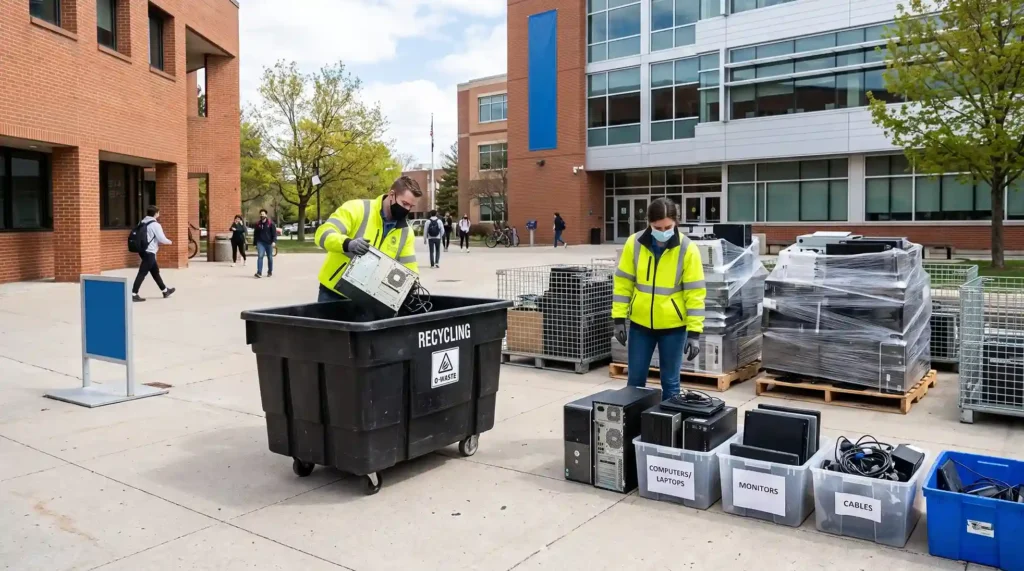
Universities and colleges can have IT equipment distributed across multiple buildings, departments, laboratories, libraries, student accommodation and administrative offices.
This makes IT equipment disposal more complicated than a normal office clearance.
A structured collection process can help an institution identify what is being removed, where it came from and what happens to it afterwards. Computer Waste describes a process involving collection, asset recording, data destruction, recycling and final reporting.
For larger refresh programmes, this type of control can be particularly useful because equipment may include hundreds of laptops, desktops, hard drives or networking devices.
Protecting Student, Staff and Research Data
Data security is one of the most important considerations when disposing of university technology.
A retired laptop could contain student records, staff information, emails, financial information or research material. Simply deleting files, emptying a recycle bin or performing an ordinary format does not necessarily provide sufficient protection.
The ICO notes that formatting alone is not sufficient for secure deletion because data may remain recoverable. It identifies secure deletion software and physical destruction as potential approaches, depending on the circumstances.
That makes secure data destruction for universities an essential part of a responsible disposal process.
Supporting Sustainability and ESG Objectives
Responsible university IT recycling can also support wider environmental objectives.
Rather than automatically destroying every device, institutions can assess whether equipment can be reused or refurbished. Devices that cannot be reused can enter appropriate electronic waste recycling streams.
This supports the principles of a circular economy by keeping useful equipment and materials in productive use where possible.
Risks of Improper IT Disposal in Higher Education
Poorly managed higher education IT disposal can create several risks.
GDPR Breaches and Data Protection Risks
Universities and colleges handle significant quantities of personal information. When data-bearing equipment reaches end of life, institutions need a process for ensuring information is securely deleted or destroyed.
The ICO states that organisations need appropriate arrangements for secure deletion and should check the credentials and processes of third parties handling personal data.
This is why GDPR compliant IT disposal should include appropriate data-security procedures, documented responsibilities and evidence of what happened to data-bearing assets.
WEEE Non-Compliance and Environmental Risks
Electrical equipment that is discarded can become WEEE. UK government guidance explains that WEEE must be managed under applicable waste controls and that the WEEE framework promotes recovery, reuse and recycling.
Universities should therefore avoid treating obsolete computers, monitors and other electrical equipment as ordinary general waste.
Using appropriate WEEE disposal services can help institutions manage their unwanted equipment through suitable recycling and recovery routes.
Reputational and Financial Consequences
A university’s IT estate is closely connected to its reputation, information governance and sustainability commitments.
A lost hard drive, poorly documented collection or irresponsible disposal process can create unnecessary questions around data security and environmental management.
Good IT asset governance provides a clearer record of what happened to equipment and helps organisations demonstrate responsible asset lifecycle management.
UK Compliance Requirements for University IT Disposal
UK GDPR and Data Protection Act Requirements
Data protection obligations do not end simply because a device is being retired.
Personal data stored on computers, laptops, external drives and other devices needs to be handled securely. The ICO recommends having appropriate processes for secure deletion and checking the security arrangements of third parties involved in data handling.
For universities, a secure disposal policy should therefore explain:
- Which assets require data destruction
- Who is responsible for approving disposal
- Which data destruction method should be used
- How assets are tracked
- What documentation must be retained
- How third-party disposal providers are assessed
Understanding WEEE Compliance for Universities
The Waste Electrical and Electronic Equipment Regulations provide the UK’s framework for managing WEEE. GOV.UK states that the regulations encourage the recovery, reuse and recycling of electrical and electronic equipment.
IT equipment falls within the scope of electrical and electronic equipment covered by the WEEE framework, with IT and telecommunications equipment listed as a category in government guidance.
Universities should therefore consider appropriate WEEE compliant IT disposal UK processes when retiring equipment.
Asset Tracking and Chain of Custody
A good disposal process should make it possible to establish what happened to each relevant asset.
Useful records can include:
- Asset number
- Serial number
- Equipment type
- Make and model
- Collection date
- Processing method
- Data destruction outcome
- Recycling or reuse outcome
- Relevant certificate or report
This creates an audit trail and supports accountability.
The IT Asset Disposal (ITAD) Process for Universities and Colleges
A professional IT asset disposal universities process can be broken down into several stages.
1. Asset Inventory and IT Equipment Collection
Start by identifying the equipment that is being retired.
This could include laptops, desktops, servers, monitors, tablets, storage devices and network equipment.
Asset information can then be recorded before collection. Computer Waste states that its asset reporting can include equipment type, make, model, serial number, asset tag and processing outcome.
2. Secure Data Erasure and Data Sanitisation
The next step is deciding how data should be removed.
Secure data erasure can allow suitable equipment to be reused while removing information from its storage media. Where reuse is not appropriate, physical destruction may be selected.
The correct method depends on the equipment, storage technology, data sensitivity and institutional requirements.
3. Hard Drive Destruction and Shredding
For devices where the storage media must not be reused, hard drive destruction services and hard drive shredding can provide physical destruction.
The ICO identifies physical destruction as one potential method of secure data destruction when the storage media no longer needs to be reused.
Computer Waste also provides physical destruction and hard drive shredding as part of its data destruction services.
4. Equipment Testing and Asset Refurbishment
Not every retired device is necessarily waste.
Where equipment remains suitable for reuse, it may be possible to securely erase the data, test the equipment and prepare it for another use.
Government guidance explains that certain used electrical equipment can remain outside the WEEE classification when specific conditions for reuse are met.
This makes asset refurbishment an important consideration within a sustainable ITAD strategy.
5. Responsible IT Recycling and E-Waste Disposal
Equipment that cannot reasonably be reused can be processed through suitable recycling routes.
Professional IT recycling services UK can help separate reusable equipment from end-of-life equipment and ensure electrical waste is handled appropriately.
Computer Waste states that it processes computers, laptops, servers, monitors, networking equipment and other IT assets for reuse, recovery or recycling.
6. Certificates and Compliance Reporting
Documentation is an important final stage.
Depending on the service and equipment, organisations may need records relating to collection, data erasure, physical destruction, recycling or asset outcomes.
A clear certificate of destruction, data erasure certificate or recycling report can help an institution maintain its internal records and demonstrate how assets were processed.
Secure Data Destruction Methods Used by Universities
Certified Data Wiping
Secure wiping can be appropriate when equipment is suitable for reuse.
The objective is to remove stored information while keeping the device functional. The process should be documented so the institution has evidence of the treatment applied.
The ICO recommends using reputable secure deletion methods and checking the credentials and processes of specialist organisations where third-party services are used.
Blancco Data Wiping
Blancco data wiping is one example of a specialist data-erasure technology used in the ITAD industry.
If a university specifies a particular technology or standard, it should verify that the provider actually uses the stated solution and can provide appropriate evidence of the process.
Physical Hard Drive Shredding
Where storage media should never be reused, physical destruction may be appropriate.
Hard drive shredding physically destroys the storage media, preventing normal recovery of the information. Computer Waste offers hard drive shredding and physical destruction services for storage media.
IT Recycling vs IT Asset Disposal: What’s the Difference?
IT recycling primarily focuses on recovering materials and responsibly processing unwanted electronic equipment.
IT asset disposal (ITAD) is broader. It can include:
- Asset identification
- Collection
- Data sanitisation
- Secure data destruction
- Refurbishment
- Reuse
- Recycling
- Asset tracking
- Reporting
- Final disposal
For a university, an ITAD approach can therefore provide a more complete framework than simply sending old computers for recycling.
Benefits of IT Asset Disposal for Higher Education Institutions
Improved Data Protection
A controlled disposal process reduces the likelihood of sensitive information remaining on retired devices.
Reduced Cybersecurity Risk
Secure data erasure or physical destruction helps prevent discarded storage devices from becoming an unintended source of information exposure.
Enhanced Sustainability
Sustainable IT disposal for universities can prioritise reuse and refurbishment before recycling where appropriate.
This approach supports the wider principles of resource efficiency and the circular economy.
Better Asset Visibility
Asset tracking gives IT departments a clearer understanding of what has left the organisation and how each item was processed.
Potential Asset Recovery
Some equipment may retain value. Depending on condition, age, specifications and market demand, suitable equipment can potentially be reused or recovered rather than immediately treated as waste.
Computer Waste states that selected high-value IT equipment may be purchased, with valuation depending on factors including quantity, condition, age, specification and current resale demand.
How to Choose an IT Disposal Company for Universities and Colleges
When comparing university IT disposal services, do not look only at collection prices.
Consider the provider’s complete process.
Look for Relevant Certifications and Credentials
Ask which certifications, licences and accreditations apply to the service being offered.
For example, Computer Waste states that it is registered with the Environment Agency and holds ISO 9001 and ISO 14001 certifications on its computer recycling service page.
If a provider claims to be ADISA certified, verify the current certification and its scope rather than relying solely on a marketing statement.
Verify Chain of Custody Procedures
Ask how equipment is controlled from the moment it leaves the university.
A reliable process should explain how assets are collected, recorded, transported, processed and reported.
Assess Data Destruction Capabilities
Ask whether the provider offers:
- Secure data erasure
- Physical destruction
- Hard drive shredding
- Onsite destruction where required
- Certificates of destruction
- Data erasure certificates
Computer Waste describes secure erasure, shredding and physical destruction options as part of its data destruction service.
Review Reporting and Audit Documentation
For large IT disposal services for higher education institutions, documentation matters.
Before signing an agreement, ask what information will be provided after collection and whether reports can be matched to asset records.
Best Practices for University IT Asset Lifecycle Management
Create a University IT Disposal Policy
A disposal policy should define responsibilities, approval procedures, data destruction requirements, environmental considerations and documentation.
Schedule Regular Asset Audits
Regular asset audits can help identify equipment approaching end of life and reduce the amount of obsolete hardware sitting in storage.
Plan for End-of-Life IT Equipment
IT disposal should be part of the asset lifecycle rather than an afterthought.
When buying new equipment, universities can consider how devices will eventually be retired, whether data can be securely erased, and how equipment can be reused or recycled.
This creates a more consistent IT asset lifecycle management process.
Frequently Asked Questions About IT Disposal for Universities and Colleges
What is IT asset disposal (ITAD)?
IT asset disposal, or ITAD, is the controlled management of IT equipment at the end of its useful life. It can include collection, asset tracking, data destruction, refurbishment, reuse, recycling and final reporting.
How do universities securely dispose of computers?
Universities should identify and track the equipment, securely erase or destroy data, assess equipment for reuse, and send end-of-life hardware through appropriate recycling or disposal channels.
What is WEEE compliance in higher education?
WEEE compliance involves managing applicable waste electrical and electronic equipment according to UK waste requirements. The UK WEEE framework encourages the recovery, reuse and recycling of electrical and electronic equipment.
Why is secure data destruction important for universities?
University devices can contain personal, financial, academic and research information. Secure data destruction helps prevent information from remaining accessible after equipment has left the institution. The ICO recommends appropriate secure deletion methods for personal data held on devices.
Can universities recycle old laptops and servers?
Yes. Laptops, servers and other IT equipment can be assessed for reuse, refurbishment or recycling. The appropriate route depends on the condition of the equipment, data-security requirements and whether the equipment has become WEEE.
What documentation should an IT disposal provider supply?
Depending on the service, documentation may include collection records, asset inventories, data erasure certificates, certificates of destruction, recycling reports and other audit records. Universities should agree the required documentation before the project begins.
Conclusion: Building a Secure, Compliant and Sustainable IT Disposal Strategy
Effective IT disposal for universities and colleges is about much more than getting rid of old computers.
A strong process brings together secure data destruction, IT asset disposal, WEEE compliance, asset tracking, responsible recycling and sustainability.
Universities and colleges should know what equipment is being retired, ensure sensitive data is securely erased or destroyed, determine whether equipment can be reused, and make sure genuine waste is handled through appropriate recycling channels.
The result is a more controlled approach to higher education IT disposal that supports information security, environmental responsibility and better asset management.
Computer Waste provides UK-wide IT recycling and data destruction services covering computers, laptops, servers, hard drives and other IT equipment, with collection, asset recording, data destruction, recycling and reporting available as part of its stated process.
Computer Waste Recycling
03303410785
46 Jellicoe Rd, Leicester LE5 4FN, United Kingdom