WEEE Recycling for Schools UK
Schools rely on electrical and electronic equipment every day, from computers and laptops to printers, monitors, projectors and networking equipment. When this equipment becomes unwanted or unusable, schools need a responsible way to manage it. WEEE recycling for schools UK helps schools move old electrical equipment into appropriate reuse, recycling, recovery or disposal routes while considering environmental, operational and data-security requirements.
For schools, recycling is not simply a matter of putting unwanted electronics in a general waste bin. The correct approach depends on whether equipment can still be reused, whether it contains data, how it should be handled and which waste route is appropriate. UK WEEE rules provide the wider regulatory framework, while schools also have responsibilities for protecting personal data held on IT equipment.
This guide explains school WEEE recycling, the equipment commonly involved, how to arrange collection, what happens to old IT equipment and how schools can choose a suitable recycling partner.
What Is WEEE Recycling for Schools?
WEEE stands for Waste Electrical and Electronic Equipment. It refers to electrical or electronic equipment that has become waste rather than equipment that is still being legitimately used or prepared for reuse.
For schools, this can include unwanted computers, laptops, monitors, printers, tablets, servers, networking equipment and other electrical devices.
The important point is that an item does not necessarily become WEEE simply because it is old. UK guidance explains that electrical and electronic equipment intended for legitimate reuse can remain EEE rather than being treated as waste, provided the relevant conditions are met.
What Does WEEE Mean?
The term WEEE is commonly used when discussing electrical equipment that a business, school or organisation no longer wants and intends to discard.
Examples can include:
- Desktop computers
- Laptops
- Tablets
- Monitors
- Printers
- Servers
- Networking equipment
- Projectors
- Chargers and other electrical accessories
- Certain other electronic equipment
The exact classification can depend on the equipment and its condition. Schools should avoid assuming that every old device is automatically waste.
What Counts as WEEE in a School?
A useful starting point is to create an inventory of unwanted electrical equipment.
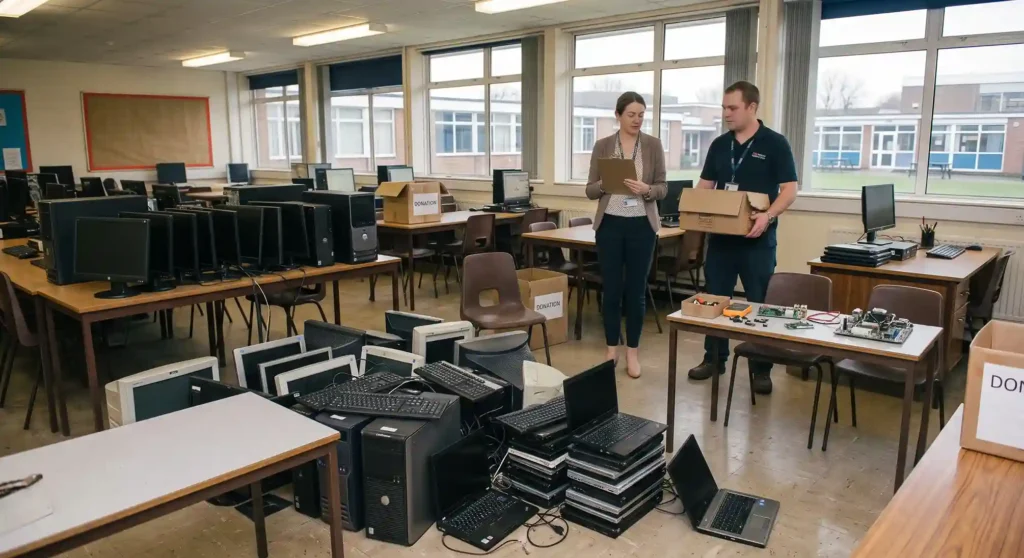
For example, a school may have a storage room containing old desktop PCs, damaged laptops, obsolete monitors and printers that are no longer being used.
Instead of immediately sending everything for recycling, the school can first identify:
- Equipment still required.
- Equipment that may be suitable for reuse.
- Equipment requiring repair or refurbishment.
- Equipment that has become waste.
- IT equipment containing data.
- Equipment requiring a specialist recycling route.
This approach makes school WEEE recycling more organised and can prevent potentially reusable equipment from being discarded unnecessarily.
Why Is WEEE Recycling Important for UK Schools?
Schools can generate electrical waste as technology is upgraded, classrooms are modernised and older equipment reaches the end of its useful life.
Responsible electrical waste recycling for schools can help schools manage unwanted equipment more effectively while supporting reuse and material recovery.
Reducing Electrical Waste
Old electrical equipment should not simply be treated as ordinary rubbish. Appropriate WEEE management helps ensure that unwanted equipment enters a suitable route for reuse, treatment or recycling.
The UK’s WEEE framework covers electrical and electronic equipment across broad categories, with the current regulations amended in 2025.
For a school, the practical goal is straightforward: identify unwanted equipment, keep it separate from unsuitable waste streams and use an appropriate route for its condition and type.
Reusing School Equipment Before Recycling
Recycling is important, but it should not always be the first option.
If a computer, laptop or other device can be legitimately reused, refurbishment or reuse may extend its useful life. Government guidance explains the distinction between equipment intended for legitimate reuse and equipment that has become WEEE.
Schools can therefore consider whether equipment could be:
- Reused in another classroom
- Reassigned to another department
- Refurbished
- Donated through an appropriate route
- Resold where suitable
- Recycled when it is no longer usable
Supporting School Sustainability Goals
School e-waste recycling can also form part of a wider environmental programme.
Schools can use their recycling programme to teach pupils about:
- Resource conservation
- Responsible consumption
- Product lifecycles
- Electronic waste
- Reuse and refurbishment
- Recycling
- The circular economy
This turns e-waste recycling for schools from a simple waste-management task into an opportunity to support environmental education.
What Electrical Equipment Can Schools Recycle?
Schools can accumulate many different types of electrical and electronic equipment.
The appropriate recycling route depends on the equipment, its condition and whether it contains components or information that require special handling.
Computers and Desktop PCs
Computer recycling for schools is one of the most common requirements because schools regularly use desktop computers in classrooms, offices, libraries and computer suites.
Old desktop computers can contain useful materials and components. Depending on condition, equipment may be suitable for reuse, refurbishment or recycling.
Before collection, schools should identify the computers being removed and consider whether they contain storage devices with school or pupil information.
Laptops and Tablets
Laptop recycling for schools is particularly important because laptops are widely used for teaching, administration and remote learning.
Schools should consider:
- Device condition
- Battery condition
- Storage media
- Personal information
- Asset identification
- Reuse potential
- Appropriate recycling
Computer Waste provides commercial laptop recycling and states that its service covers redundant devices and mixed batches from workplaces, schools and commercial sites. Its published service information also highlights battery-aware handling and nationwide collections.
Monitors and Screens
Old monitors can also form part of a school’s electrical waste.
Schools may have older LCD screens, larger displays or obsolete monitors following an IT upgrade.
Rather than placing unwanted screens into general waste, schools should arrange an appropriate electrical recycling route.
Printers and Scanners
Printers and scanners are another common source of school electrical waste.
When replacing printers, schools should identify the old units and any related electrical equipment that needs to be removed.
A professional recycling service can help schools manage larger collections of mixed IT equipment rather than arranging separate disposal routes for every device.
Servers and Networking Equipment
Larger schools, academies and multi-site organisations may also have servers, switches, routers and other networking equipment.
These devices may contain storage media or configuration information, so school IT equipment disposal should include data and asset considerations where relevant.
Chargers, Cables and Small Electrical Equipment
Schools can also accumulate chargers, power supplies, cables and smaller electronic devices.
These should be assessed and directed to an appropriate recycling route rather than assuming that small electrical items can be placed in ordinary waste.
WEEE Recycling Rules for Schools in the UK
The UK WEEE Regulations 2013, as amended, provide the underlying legislative framework for WEEE. The government states that the regulations were amended by the Waste Electrical and Electronic Equipment (Amendment, etc.) Regulations 2025.
Understanding the UK WEEE Regulations
The regulations cover electrical and electronic equipment across 15 broad categories. The precise obligations can differ depending on whether an organisation is a producer, distributor, collector, treatment facility or waste producer.
For schools arranging disposal, the practical priority is to ensure that unwanted electrical equipment is handled through an appropriate waste route and that relevant waste-management responsibilities are met.
When Does Electrical Equipment Become WEEE?
This distinction matters.
An old laptop that is still working is not automatically WEEE simply because the school no longer needs it. Government guidance sets out conditions for determining when EEE can be reused without becoming WEEE. It also states that WEEE must be managed according to applicable waste requirements.
Schools should therefore separate equipment intended for reuse from equipment that is genuinely being discarded.
School Waste Responsibilities
When electrical equipment becomes waste, schools should consider their waste duty of care and the appropriate documentation.
Government guidance notes that transporting WEEE requires compliance with duty-of-care requirements, including appropriate waste transfer documentation for relevant non-hazardous waste or a consignment note for hazardous waste.
If a school is unsure about the classification or correct disposal route for a particular item, it should obtain appropriate professional or regulator guidance rather than guessing.
England, Scotland, Wales and Northern Ireland
The Environment Agency applies in England, while the Scottish Environment Protection Agency, Natural Resources Wales and Northern Ireland Environment Agency have responsibilities in the other nations.
Schools should therefore check the guidance applicable to the country in which their site operates.
How Do Schools Recycle Electrical Equipment?
A structured process makes recycling electrical equipment in schools easier to manage.
Step 1: Audit Old Electrical Equipment
Start by creating a list of unwanted equipment.
Record information such as:
- Equipment type
- Quantity
- Make and model
- Asset number
- Condition
- Location
- Whether the item contains storage media
- Whether it may be suitable for reuse
A basic inventory helps a school understand what it actually needs to remove.
Step 2: Separate Reusable Equipment
Identify equipment that still has a practical use.
A working laptop might be reassigned, refurbished or sent through a legitimate reuse route rather than immediately treated as waste.
This is particularly relevant because government guidance distinguishes legitimate EEE for reuse from WEEE.
Step 3: Identify WEEE
After the reuse assessment, identify equipment that is genuinely being discarded.
This could include broken computers, obsolete monitors, damaged printers or other unwanted electrical equipment.
Step 4: Prepare Equipment for Collection
Keep equipment organised before collection.
For IT equipment, schools should also identify devices containing storage media and follow their internal data-protection procedures.
Step 5: Arrange Collection and Recycling
Schools can arrange a suitable WEEE collection for schools through an appropriate recycling provider.
Computer Waste states that it provides nationwide collections and handles computers, laptops, servers, networking equipment, printers, monitors and other IT equipment.
Depending on the equipment and collection circumstances, services may be free or chargeable. Computer Waste states that its collection options depend on factors such as equipment quantity, type, quality and location.
Step 6: Keep Appropriate Records
Keep relevant collection, asset and recycling documentation.
This can help a school maintain an audit trail showing what equipment was removed and how it was handled.
IT Recycling for Schools: Computers, Laptops and Other Devices
IT recycling for schools deserves special attention because school IT equipment can contain both valuable materials and sensitive information.
A school IT recycling programme may include:
- Desktop computers
- Laptops
- Tablets
- Servers
- Hard drives
- Monitors
- Networking equipment
- Printers
- Other IT hardware
Computer Waste’s published process includes collection, secure transportation, inventory, data destruction and final reporting and certification.
Computer Recycling for Schools
With computer recycling for schools, the objective is to ensure that unwanted computers are assessed and directed into appropriate reuse, recovery or recycling routes.
Where storage devices contain information, data handling should be considered before equipment leaves the school’s control.
Laptop and Tablet Recycling
Schools should treat laptops and tablets as both electrical equipment and potential data-storage devices.
Battery condition should also be considered. Computer Waste specifically highlights battery-aware handling for laptop recycling.
School IT Equipment Disposal
School IT disposal should be more than simply removing old devices.
A good process should consider:
- Asset identification.
- Data security.
- Reuse potential.
- Secure collection.
- Appropriate recycling.
- Documentation.
What Happens to Old School Computers?
Old computers can follow different routes depending on their condition.
Some may be suitable for reuse or refurbishment. Others may need to be processed for material recovery and recycling.
Computer Waste explains that collected equipment is assessed for reuse, refurbishment, recycling or secure data destruction, with reporting and certification available where required.
Recycle Your School IT Equipment Responsibly
Ready to clear out old computers, laptops and electrical equipment? CWR can help you manage your unwanted IT equipment responsibly.
Request a Collection
Secure Data Destruction When Recycling School IT Equipment
Data security is one of the most important considerations when disposing of school computers.
Why Data Security Matters
Schools handle personal information relating to pupils, parents, staff and other individuals.
The Department for Education states that schools, academies and trusts must comply with data-protection legislation and have appropriate data-protection policies and procedures.
That means secure IT disposal for schools should include a clear approach to information stored on devices.
Data Wiping and Data Destruction
Depending on the equipment and circumstances, appropriate data destruction may involve secure data wiping or physical destruction of storage media.
Schools should have a documented procedure for deciding how information is removed before equipment is reused, recycled or destroyed.
DfE guidance says personal data that has reached the end of its retention period must be disposed of securely and confidentially, and that disposal procedures should be documented.
Certificates and Disposal Records
Documentation can provide evidence that equipment and data were handled through the intended process.
When choosing a provider for data destruction school computers, schools can ask what records and certificates will be supplied after the service.
Computer Waste states that its process includes certified data destruction and final reporting and certification.
How to Choose a WEEE Recycling Service for Your School
Choosing a suitable WEEE recycling service UK provider involves more than comparing collection prices.
Check the Recycling Provider’s Credentials
Ask whether the provider is appropriately authorised and whether its treatment and recycling arrangements meet relevant requirements.
The Environment Agency explains that approved authorised treatment facilities can receive and treat WEEE under the relevant regulatory framework.
Ask About Collection Services
- Where collections are available
- What equipment is accepted
- Whether there are minimum quantities
- Whether collection is free or chargeable
- How equipment is transported
- What documentation is supplied
Computer Waste states that it provides nationwide collections and that collection eligibility can depend on equipment type, quantity, quality and location.
Check Data Destruction Procedures
For computers, laptops and servers, ask how storage devices are handled.
A provider should be able to explain its data destruction process clearly rather than simply saying that equipment will be recycled.
Ask What Documentation You Receive
A professional WEEE collection service for schools should make the outcome clear.
Depending on the service, documentation may include collection records, asset information, data-destruction records or certificates.
Need WEEE Recycling for Your School?
Give your old IT equipment a responsible next step. Arrange a WEEE and IT recycling collection with CWR.
Get Started with CWR
What Happens to WEEE After a School Collection?
Once equipment has been collected, it can be assessed and separated according to its condition and intended treatment.
Collection and Sorting
Equipment can be inventoried and assessed.
Working or recoverable equipment may have reuse potential, while equipment that cannot reasonably be reused can move into an appropriate recycling or treatment route.
Reuse and Refurbishment
Reuse can extend the useful life of equipment and reduce the need for new hardware.
This is why schools should identify potentially reusable devices before automatically classifying everything as waste.
Recycling and Material Recovery
Where equipment is no longer suitable for reuse, it can enter appropriate WEEE treatment and recycling processes.
The Environment Agency’s guidance for WEEE treatment refers to reuse and treatment in line with appropriate regulatory requirements and best available treatment, recovery and recycling techniques.
How Schools Can Reduce Electrical and Electronic Waste
Good school electrical waste recycling starts before equipment becomes waste.
Buy Durable Equipment
When purchasing new technology, schools can consider durability, repairability, support availability and expected useful life.
Buying equipment that can remain useful for longer can reduce replacement frequency.
Repair and Reuse Equipment
A device with a minor fault may not need to become waste immediately.
Where practical, repair or refurbishment can extend the useful life of equipment.
Donate or Reuse Suitable Devices
Working equipment may have a potential second life, subject to the school’s policies, data-security requirements and the legal conditions governing reuse.
Recycle Equipment Responsibly
When equipment genuinely reaches the end of its useful life, school e-waste recycling provides a route away from inappropriate disposal.
Schools should avoid mixing electrical waste with general waste and should use suitable recycling or waste-management arrangements.
School WEEE Recycling Checklist
Use this checklist when preparing a school electrical waste collection:
- Audit unwanted electrical equipment.
- Record relevant asset information.
- Separate reusable equipment from WEEE.
- Identify computers, laptops and storage devices.
- Follow the school’s data-retention and data-destruction procedures.
- Separate batteries where the appropriate waste route requires it.
- Identify the correct WEEE recycling route.
- Check the recycling provider’s credentials.
- Confirm collection requirements.
- Arrange secure collection.
- Obtain relevant documentation.
- Keep records of equipment removed and its treatment.
Frequently Asked Questions About WEEE Recycling for Schools
What is WEEE recycling for schools?
It is the responsible reuse, treatment, or recycling of unwanted electrical and electronic equipment from schools.
How do schools recycle electrical equipment?
Schools should audit equipment, separate reusable items, protect data, and arrange collection through an appropriate recycling provider.
What electrical items can schools recycle?
Schools can recycle computers, laptops, tablets, monitors, printers, servers, and other electrical equipment.
How do schools dispose of old computers?
Schools should check for reuse potential, securely handle data, and use an appropriate IT recycling or WEEE disposal route.
How should schools securely dispose of computers?
Schools should follow data-protection procedures and ensure personal or sensitive information is securely erased or destroyed before recycling.
Conclusion
Effective WEEE recycling for schools UK is about more than getting rid of old electrical equipment. Schools need to consider what equipment they have, whether it can be reused, whether it contains sensitive information and which recycling or disposal route is appropriate.
A practical school WEEE programme can begin with an equipment audit, followed by reuse assessment, secure data handling, appropriate collection and responsible recycling.
For schools with larger quantities of computers, laptops, monitors, servers and other IT equipment, working with an experienced recycling provider can simplify the process. Computer Waste provides nationwide IT recycling and collection services, including computer recycling, laptop recycling, data destruction and related IT asset services.
Schools should always check the latest government and environmental-regulator guidance for their specific circumstances, particularly where waste classification, hazardous components, data protection or reuse is involved.
Clear Out Your Old School Computers
From laptops and computers to other IT equipment, make your next clear-out easier with a professional recycling service.
Contact CWR Today
Computer Waste Recycling
03303410785
46 Jellicoe Rd, Leicester LE5 4FN, United Kingdom